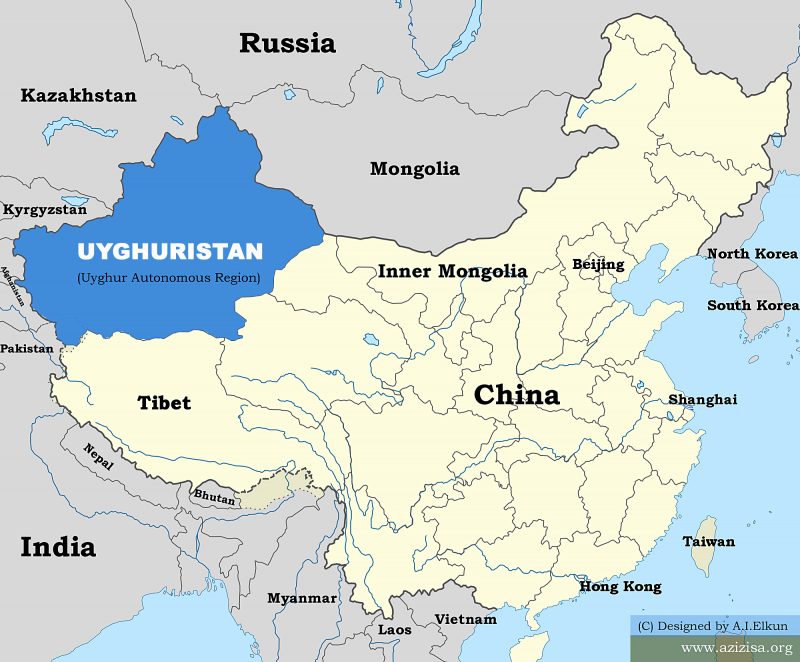
Posts in "Articles"

Chinese colonialism in translation

Chinese colonialism in translation: Translation of Uyghur names into mandarin under communist China 

Aziz Isa Elkun

Chinese colonialism in translation

In this paper I focus on the historical and contemporary context and conception of Uyghur names and places in translation under the Manchu Qing dynasty, Chinese Nationalists and Chinese communist rulers of the region in the last two centuries. More recently this has combined with the current so called ”Bilingual education” policies that have unofficially abandonned Uyghur language instruction in Uyghur education to produce a real threat to Uyghur identity and sense of ownership over this territory.

It is useful to remind ourselves that similar procedures and methods were applied by the British and Russian empires during their vast colonial exapnsion over the last three centuries, and it is now aggressively copied and implemented by China in the Xinjiang Uyghur Autonomous Region.

I ask whether the Chinese state can ultimately achieve its Sinification of Uyghur geographical place names, or whether Uyghurs will be able to preserve the Uyghur language names that currently co-exist with the Chinese names in the Uyghur region.  

With the lack of Uyghur language representation in the Chinese official press and in international media, will there be any future change in the current understanding, usage and representation of Uyghur language names and Mandarin names in the Uyghur region. It is likely that the situation will become still more problematic after China’s recent more agressive implementation of Chinese language usage among the Uyghur people.

If we look at history we can see that western colonial powers were able to obtain the wealth by depending on their warship and cannons. In return they introduced their own culture and languages to the the local inhabitants and even renamed the indigenous peoples names and their towns. This all ultimately helped to achieve a full colonization of the subject countries.  
Read More

Response to the Chinese Global Times & CGTN

Aziz Isa Elkun
Research affiliate, SOAS, University of London
ai18@soas.ac.uk  |  www.azizisa.org/en

After my recent interview with CNN about the destruction of my father’s tomb, Chinese Global Times and China Global Television Network specifically responded spreading fault information about the destruction of my father’s tomb by forcing my 78 years old mother to give an interview. The GT and CGTN claim that they respect Uyghur and other Muslim nationalities graveyards and burial traditions in East Turkistan (Xinjiang), but the claims made about me in the article are not correct.

They said: “Aziz Isa Elkun claimed he could not find his father’s grave, which was located in Xayar county in Aksu Prefecture, from a satellite image on Google. However, instead of checking with his family in Xinjiang, the Uygur poet opted to tell the media of his discovery.”

Let me clarify this:

My father worked for 40 years as a medical doctor for Shayar County, Toyboldi town hospital. He died on 4th November 2017. I heard about his death four days later through a friend. Soon before the end of 2017, all my telephone communication with my mother was cut off. I had no news about my mother and other relatives from our village for more than two years, when I learned from friends living outside the region that my mother was alive and that my sister had been detained in an interment camp for more than a year and a half. I still have no news of my other relatives. Thanks to this Global Times TV Network report I have now heard my mother’s voice for the first time since February 2017.

Read More

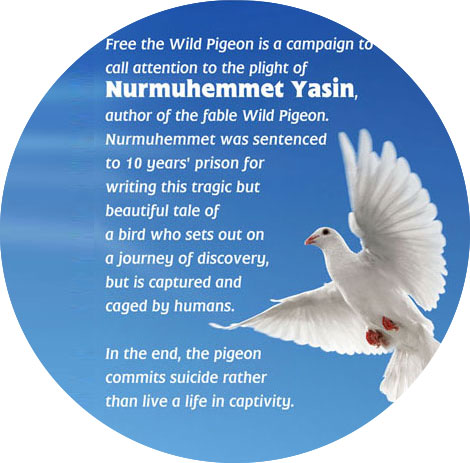
Let’s write for freedom, let the “Wild pigeon” go free!

“Nurmemet

Aziz Isa Elkun
(Secretary of International PEN Uyghur Centre)

ئەركىنلىك ئۈچۈن يازايلى، «ياۋا كەپتەر» ئەركىن پەرۋاز قىلسۇن

* My speech at “The First International Conference of Four-PEN Platform” held in Malmö City hall in Sweden on 28 August 2017.

Dear ladies and gentlemen, friends and colleagues of the PEN, I am honoured to be here to speak on behalf of the Uyghur PEN Center and for the Uyghur people who are almost entirely denied freedom of expression by China in this digital era of the 21st century !

As we are writers, translators and intellectuals in many artistic and cultural fields gathered here to find common ground – the slogan ‘no enemies, no hatred’ is easily said, but in the current reality for Uyghurs in their homeland of East Turkestan (also known as Xinjiang Uyghur Autonomous Region), who are now suffering from unprecedented oppression and lack of rights, this is a hard goal to achieve. But the hate that separates us from each other – which may be based on race, religion or gender or other types of discrimination – will fail, because that hate is artificially bred by governments or other power holders to achieve their aims. The history of humanity always reminds us that tolerance and forgiveness are the only remedies that can achieve peace and prosperity for all of us in the global village.

Read More